Engineering Geology, Second Edition
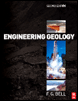
Illustrating key points with diagrams and photographs, this book introduces the techniques that engineers will need to learn about and understand the geological conditions in which they intend to build.
 TABLE OF CONTENTS
 The principal source of groundwater is meteoric water, that is, precipitation. However, two other sources are occasionally of some consequence. These are juvenile water and connate water. The former is derived from magmatic sources, whereas the latter represents the water in which sediments are deposited. Connate water is trapped in the pore spaces of sedimentary rocks as they are formed and has not been expelled.
The amount of water that infiltrates into the ground depends on how precipitation is dispersed, namely, on the proportions that are assigned to immediate run-off and to evapotranspiration, the remainder constituting the proportion allotted to infiltration/percolation. Infiltration refers to the seepage of surface water into the ground, percolation being its subsequent movement, under the influence of gravity, to the zone of saturation. In reality, one cannot be separated from the other. The infiltration capacity is influenced by the rate at which rainfall occurs (which also affects the quantity of water available), the vegetation cover, the porosity of the soils and rocks, their initial moisture content and the position of the zone of saturation.
The retention of water in soil depends on the capillary force and the molecular attraction of the particles. As the pores in the soil become thoroughly wetted, the capillary force declines, so that gravity becomes more effective. In this way, downward percolation can continue after infiltration has ceased but the capillarity increases in importance as the soil dries. No further percolation occurs after the capillary and...