Engineering Geology, Second Edition

Illustrating key points with diagrams and photographs, this book introduces the techniques that engineers will need to learn about and understand the geological conditions in which they intend to build.
 TABLE OF CONTENTS
 The two most important features that are produced when strata are deformed by earth movements are folds and faults, that is, the rocks are buckled or fractured, respectively. A fold is produced when a more or less planar surface is deformed to give a waved surface. On the other hand, a fault represents a surface of discontinuity along which the strata on either side have been displaced relative to each other.
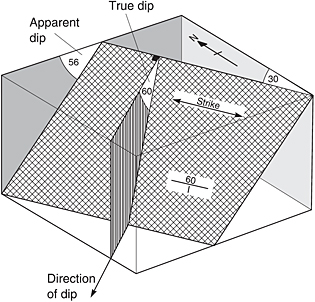
There are two important directions associated with inclined strata, namely, dip and strike. True dip gives the maximum angle at which a bed of rock is inclined and should always be distinguished from apparent dip (Fig. 2.1). The latter is a dip of lesser magnitude whose direction can run anywhere between that of true dip and strike. Strike is the trend of inclined strata and is orientated at right angles to the true dip, it has no inclination (Fig. 2.1).
Folds are wave-like in shape and vary enormously in size. Simple folds are divided into two types, that is, anticlines and synclines (Fig. 2.2a and b). In the former, the beds are convex upwards, whereas in the latter, they are concave upwards. The crestal line of an anticline is the line that joins the highest parts of the fold, whereas the trough line runs through the lowest parts of a syncline (Fig. 2.2a). The amplitude of...