Essentials of Lean Six Sigma

The automation system of a manufacturing company X during the fall quarter had over 45% downtime, resulting in an additional labor cost of $140,000 $145,000. If this trend continues within a year, the labor cost will exceed $500,000. A team of engineers and production staff were assigned to study the case. The objective is to reduce total downtime by at least half to a maximum of 22.5% and not to exceed that thereafter. This would allow customer demand to be met without the requirement of overtime and about 100,000 parts per week, which makes about 40% of X product.
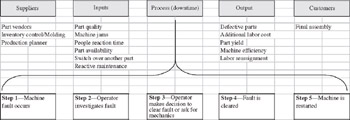
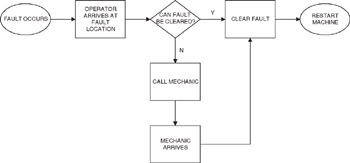
First, the Lean Six Sigma team began with a process map SIPOC and flowchart, as shown in Figures 9.1 and 9.2, to clearly understand the process itself.
All process outputs relevant to downtime are attributing in nature and recorded in a networked database. Some of the issues that cause machine downtime are as follows:
Fault description and frequency
Machine data detailing all faults.
Lack of parts
Downtime accrued when the automation system does not run due to the lack of availability of a particular part in the assembly.
Jam parts
Downtime accrued when the automation system stops for a machine station fault until the time the machine is restarted.
Reactive maintenance (RM)
Downtime accrued during the time...