Essentials of Lean Six Sigma

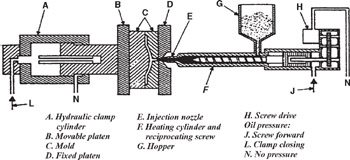
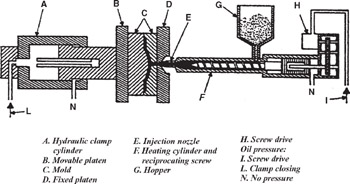
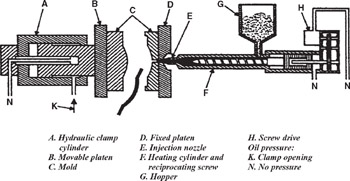
A great deal of emphasis has been placed on the repeatability of the injection molding operation (Figures 10.1 through 10.4, for a typical injection molding machine refer to Figure 6.7) through the use of feedback control techniques. However, it is the molded parts whose quality determines performance, sale, and reputation. There are inherent changes that occur in the processing conditions with time that might affect such properties. Variation in the material composition, molecular weight, or molecular weight distribution from lot to lot cannot be compensated for by maintaining machine repeatability. Neither can variations in the proportion or quality of regrind in the feed. The thermal degradation of hydraulic fluid, changes in the heater-band characteristics, and wear in the barrel or screw could also call into question the ability of the press (injection molding machine) to make equivalent parts through the life of the machine.
An experimental study of injection molding was conducted by using a three-factor composite design with the independent variables injection pressure (Hi = 14,000 psi, Low = 6,000 psi); injection velocity (Hi = 80 mm/sec, Low = 40 mm/sec); and plasticating screw speed (Hi = 200 rpm, Low = 100...