Hybrid Membrane Systems for Water Purification: Technology, Systems Design and Operation
2.3: Membrane Fouling, Scaling, and Controls

2.3 Membrane Fouling, Scaling, and Controls

One of the limitations of membrane processes or liquid separations is severe loss of productivity due to concentration polarisation and fouling, as discussed in Chapter 1. The drop in flux can be as much as 80% in a few minutes or may take days. The loss of productivity is substantial vis- -vis membrane permeability measured with water. [18] [19] [20] [26] Several novel techniques for controlling fouling and enhancing flux are given in Tables 1.13 and 1.15.

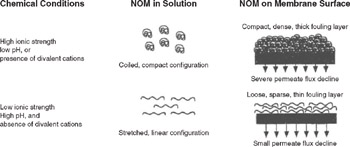
Membrane pretreatment processes discussed earlier are designed to minimise the potential problems of scaling resulting from the precipitation of the slightly soluble ions because these foul the membranes relatively quickly. Scaling is largely due to the deposition of colloidal materials in close proximity to the membrane surface that often results in fouling. One problem with scaling in membrane systems is that the process introduces a large amount of potential foulants in the system, for example colloidal fouling occurs if total suspended solids (TSS) are too high. Cakes of colloids formed on the membrane surface result in blinding the membranes reducing the flux drastically in most cases, as shown in Figure 2.13. Thus the efficiency of a membrane system, especially the life of a RO or a NF membrane (RO and NF membranes are less rugged than UF and MF membranes) depends on effective treatment of the membrane system feed water.


Figure 2.13: Effect of solution chemistry on the deposition of natural organic matter (NOM) on a membrane...

UNLIMITED FREE
ACCESS
TO THE WORLD'S BEST IDEAS

SUBMIT
Already a GlobalSpec user? Log in.

This is embarrasing...

An error occurred while processing the form. Please try again in a few minutes.

Customize Your GlobalSpec Experience

Category: Membrane Bioreactors
Finish!
Privacy Policy

This is embarrasing...

An error occurred while processing the form. Please try again in a few minutes.