Hybrid Membrane Systems for Water Purification: Technology, Systems Design and Operation
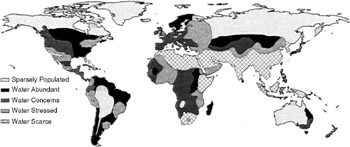
Water is the world's most valuable and wasted resource. With growing demand outstripping supply in many regions of the world, the situation is likely to get exasperated by the year 2020 as shown in Figure 2.41. Estimated use of the world's water in 1996 was as follows: approximately 63% for agriculture, 25% for industry, 7% for cities, and 5% for system losses. [51]
Less than three percent of the world's water has a salinity content that can be considered safe for human consumption. According to the World Health Organisation (WHO), the total dissolved solids (TDS) should be less than 1,000 mg/l (ppm) in drinking water based on taste considerations. By comparison seawater has an average TDS of 35,000ppm and brackish water TDS varies between 1,000 and 10,000ppm. It is estimated that less than 1.0% of the world's water supply is easily accessible and has acceptable water quality. According to the National Council Research Report, [7] the principal water problem in the early twenty-first century will be inadequate and uncertain supplies. Since water availability includes both water quality and quantity, reduction in water quality due to water pollution will further diminish the available water supply. World's water needs, however, can be met by better water management, e.g. by reducing losses using micro-irrigation techniques most of the 66% water lost during irrigation can be recovered, [51] by using advanced water treatment technologies for treating polluted water and...