Materials Science in Microelectronics: The Effects of Structure on Properties in Thin Films, Volume II, Second Edition
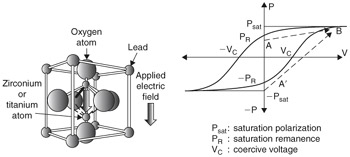
High dielectric constant materials also have application as thin film capacitors for dynamic random-access memories (DRAM), non-volatile ferroelectric random-access memories (NVFRAM), piezoelectric films for MEMS, for tunable microwave components, phase shifters, resonators, etc. Ferroelectric materials having the perovskite structure are being considered for these applications. This structure is illustrated in Figure 1.22 and derives its high polarization from the fact that the structure does not have inversion symmetry. For the specific case of Pb(Zr, Ti)O 3 shown in Figure 1.22 this lack of inversion symmetry corresponds to the off body-centered-cubic equilibrium position of the Zr,Ti ions. There are six such equilibrium points for these ions in the unit cell and the point occupied determines the direction of polarization and the c-axis of the tetragonal unit cell.
In order to function as a memory device the capacitor unit must be able to be switched from one polarization to the reverse polarization. Hence, the capacitor unit in the device must have one orientation of the polarization vector at the start and be capable of being switched to the reverse polarization. Considering that the capacitor film is constrained to a substrate, that the film itself is subject to stress induced by both the transformation strain on being cooled through the Curie temperature separating one crystal structure (e.g. cubic) from...