Newnes Mechanical Engineer's Pocket Book, Third Edition
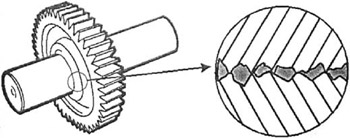
These are high-strength adhesives widely used in the engineering industry. Anaerobic adhesives are single-compound materials that remain inactive when in contact with oxygen. The adhesives require two conditions to be present simultaneously in order to cure. That is, the absence of oxygen and in the presence of metal parts. These adhesives are widely used for threadlocking, threadsealing, gasketing and retaining (or cylindrical part bonding) at room temperature where ideal conditions exist for the adhesive to cure as shown in Fig. 1.
Copper, brass and plain carbon steel are active as far as anaerobic adhesives are concerned and result in rapid curing at normal room temperatures. Stainless steel, aluminium and aluminium alloys, and plated products are passive and require the use of an activator to ensure a full cure. As a liquid, the adhesive flows into the interstitial spaces between the male and female components of the joint where, devoid of atmospheric oxygen it cures and becomes keyed to the surface roughness. The curing process is also stimulated by contact between the adhesive and the metal surface that acts as a catalyst in the case of active . Once cured to provide a tough thermoset plastic, the adhesive provides up to 60% of the torsional strength of the joint as shown in Fig. 2a. To...