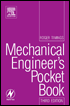
Newnes Mechanical Engineer's Pocket Book, Third Edition
Chapter 5: Power Transmission

5.1 Power transmission: gear drives

5.1.1 Some typical gear drives

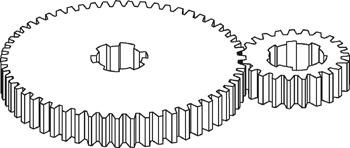
Straight tooth spur gears

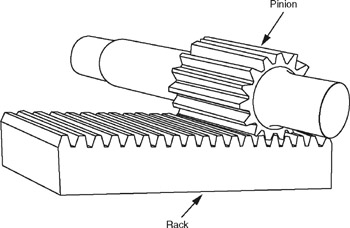
Rack and pinion: converts rotary to linear motion

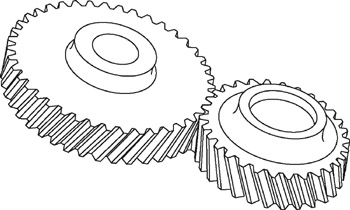
Single-helical tooth spur gears

Double-helical tooth spur gears

Straight tooth bevel gears

Worm and worm wheel

5.1.2 Simple spur gear trains

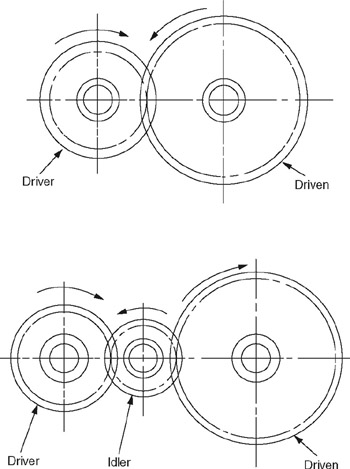
Simple train

  1. Driver and driven gears rotate in opposite directions.

  2. The relative speed of the gears is calculated by the expression:


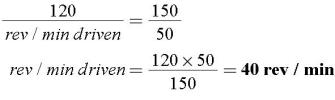
Calculate the speed of the driven gear if the driving gear is rotating at 120 rev/min. The driven gear has 150 teeth and the driving gear has 50 teeth:


Simple train with idler gear

  1. Driver and driven gears rotate in the same direction if there is an odd number of idler gears, and in the opposite direction if there is an even number of idler gears.

  2. Idler gears are used to change the direction of rotation and/or to increase the centre distance between the driver and driven gears.

  3. The number of idler gears and the number of teeth on the idler gears do not affect the overall relative speed.

  4. The overall relative speed is again calculated using the expression:


5.1.3 Compound spur gear train

  1. Unlike the idler gear of a simple train, the intermediate gears of a compound train do influence the overall relative speeds of the driver and driven gears.

  2. Both intermediate gears ( l 1 and l 2) are keyed to the same shaft and rotate at the same speed.

  3. Driver and driven gears rotate in the same direction. To reverse the...

UNLIMITED FREE
ACCESS
TO THE WORLD'S BEST IDEAS

SUBMIT
Already a GlobalSpec user? Log in.

This is embarrasing...

An error occurred while processing the form. Please try again in a few minutes.

Customize Your GlobalSpec Experience

Category: Gear Manufacturing Services
Finish!
Privacy Policy

This is embarrasing...

An error occurred while processing the form. Please try again in a few minutes.