Newnes Mechanical Engineer's Pocket Book, Third Edition

Chapter 6: Engineering Materials

6.1 Mechanical properties

6.1.1 Tensile strength

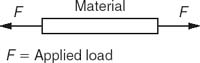
This is the ability of a material to withstand tensile (stretching) loads without rupture occurring. The material is in tension.

6.1.2 Compressive strength

This is the ability of a material to withstand compressive (squeezing) loads without being crushed or broken. The material is in compression.

6.1.3 Shear strength

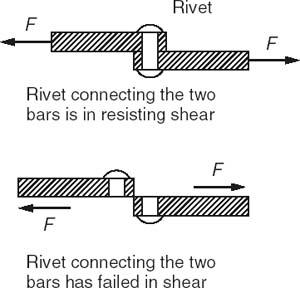
This is the ability of a material to withstand offset or transverse loads without rupture occurring. The rivet connecting the two bars shown is in shear whilst the bars themselves are in tension. Note that the rivet would still be in shear if the bars were in compression.

6.1.4 Toughness: impact resistance

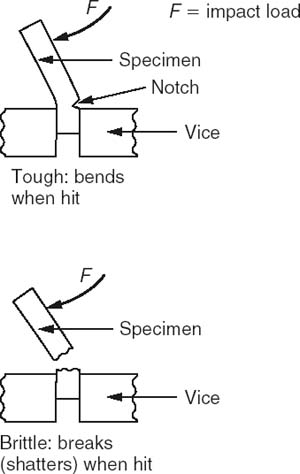
This is the ability of a material to resist shatter. If a material shatters it is brittle (e.g. glass). If it fails to shatter when subjected to an impact load it is tough (e.g. rubber). Toughness should not be confused with strength. Any material in which the spread of surface cracks does not occur or only occurs to a limited extent is said to be tough.

6.1.5 Elasticity

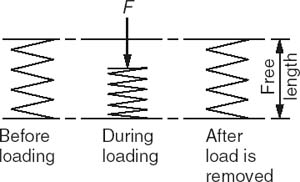
This is the ability of a material to deform under load and return to its original size and shape when the load is removed. Such a material would be required to make the spring as shown.

6.1.6 Plasticity

This property is the exact opposite of elasticity. It is the state of a material which has been loaded beyond its elastic state. Under a load beyond that required to cause elastic deformation (the...

UNLIMITED FREE
ACCESS
TO THE WORLD'S BEST IDEAS

SUBMIT
Already a GlobalSpec user? Log in.

This is embarrasing...

An error occurred while processing the form. Please try again in a few minutes.

Customize Your GlobalSpec Experience

Category: Mechanical Testing Services
Finish!
Privacy Policy

This is embarrasing...

An error occurred while processing the form. Please try again in a few minutes.