Offshore Pipelines
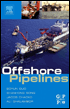
Written primarily for engineers and management personnel working on offshore and deepwater oil and gas pipelines, this text sets forth guidelines that can be employed to optimize pipeline development projects.
 TABLE OF CONTENTS
 Various methods have been used in subsea pipeline installations. This part of the book provides a brief description of these methods and focuses on engineering aspects of controlling bending stress and stability of pipeline during the installation. It includes the following chapters:
With the discovery of offshore oil fields in the shallow waters of the Gulf of Mexico during the late 1940s, offshore pipeline installation was invented. The first offshore pipeline in the Gulf of Mexico was constructed in 1954. Now, offshore fields are being discovered in water depths of 10,000 feet and the pipeline installation technology is keeping up. The most common methods of pipeline lay installation methods are:
S-lay (Shallow to Deep)
J-lay (Intermediate to Deep)
Reel lay (Intermediate to Deep)
Shallow water depth ranges from shore to 500 feet. Intermediate water depth is assumed to be 500 feet to 1000 feet. Deepwater is water depths greater than 1000 feet. Offshore magazine produces a survey of most of the pipeline lay barges that work in the US every year. This survey does not cover all the lay barges of all the countries that do offshore work, but it does cover the bigger international ones Heerema, Saipem, Stolt, Technip, Allseas, McDermott, Global, and Subsea 7.
Other methods that have been used for pipeline installation are tow methods consisting of:
Bottom tow