Offshore Pipelines
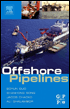
Written primarily for engineers and management personnel working on offshore and deepwater oil and gas pipelines, this text sets forth guidelines that can be employed to optimize pipeline development projects.
 TABLE OF CONTENTS
 Offshore steel pipelines are normally designed for a life ranging from 10 years to 40 years. To enable the pipeline to last for the design life, the pipeline needs to be protected from corrosion both internally and externally. Internal corrosion is related to fluid that is carried by the pipeline, and this topic is not covered here. This chapter describes the method by which the external corrosion of offshore pipelines may be minimized.
A strong adhesive external coating over the whole length of the pipeline will tend to prevent corrosion. However, there is always the possibility of coating damage during handling of the coated pipe either during shipping or during installation. Cathodic protection is provided by sacrificial anodes to prevent the damaged areas from corroding.
This first external pipe coating layer is used to protect the pipe against corrosion. A single-layer coating is used when the installed pipeline is always in a static, laterally stable condition lying on soils such as clay or sand. Additional layers of coating are used for additional protection, for weight to help the pipeline remain laterally stable on the seabed, or for providing insulation. A multi-layer coating is generally used in cases where the external environment tends to easily wear out the external coating (e.g., pipeline lying on top of rocky soil, calcareous material, etc.). Insulation is provided to maintain a higher temperature of the flowing internal fluid compared to the ambient. Depending on the external environment and on...