Offshore Pipelines
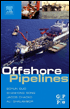
Written primarily for engineers and management personnel working on offshore and deepwater oil and gas pipelines, this text sets forth guidelines that can be employed to optimize pipeline development projects.
 TABLE OF CONTENTS
 Flexible pipes have been used in the oil industry since 1972, when Coflexip was awarded a patent to build a high pressure, flexible steel pipe. The first application was used in drilling as a 15,000 psi Kill and Choke line. Since then, flexible pipe designs have improved to produce the flowlines and risers that are now used in the offshore oil industry.
For deepwater, the flexible pipes are used mainly for dynamic risers from a subsea pipeline end manifold (PLEM) or riser tower to a floating production system such as an FSO, FPSO, and TLPs. The other uses are static risers, static flowlines, subsea jumpers, topside jumpers, and expansion joints. Flexible pipes are used for versatile offshore oil and gas applications including production, gas lift, gas injection, water injection, and various ancillary lines including potable water and liquid chemical lines.
The main advantages of flexible pipelines are:
Ease and speed of installation
No large spans because it follows the contours of the seabed
Almost no maintenance for life of the project
Good insulation properties are inherent
Excellent corrosion properties
No field joints because the pipe is of continuous manufacture
No need of expansion loops
Can be made with enhanced flow characteristics
Sufficient submerged weight for lateral stability
Accommodates misalignments during installation and tie-in operations
Diverless installation is possible no metrology necessary
Load-out and installation is safer, faster, and cheaper than any other pipe application
Retrievability and...