A Practical Guide to CRM

This book is a guide to achieving customer satisfaction by choosing the right CRM systems, and explains how to use CRM to integrate all channels of customer contact.
 TABLE OF CONTENTS
 It's fairly easy to put together a committed CRM team, and with a good business case, it's not too difficult to get the executive suite's buy-in for a CRM initiative; yet the actual creation of a CRM strategy can be quite elusive. Nevertheless, the benefits of a well-developed CRM strategy increased sales, new ways to differentiate the company and its product in the marketplace, the ability to absorb new business methods (i.e. the Internet) add substance to the cost savings used to support most CRM initiatives.
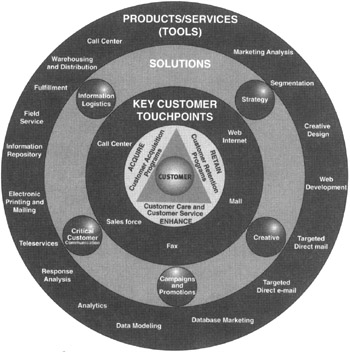
Customer relationship management itself is a business philosophy that adopts a strategy. Both place the customer at the heart of the corporate culture thereby compelling a re-engineering of a business's processes and activities. It is NOT an application, a technology or a suite of products.
A CRM strategy usually requires a cultural shift aligning the company, its employees and systems towards its customers (a customer-centric philosophy) and away from its tried-and-true product- or process-centric philosophies that focus on cutting costs and improving efficiency through optimization of internal processes and automation of back-office functions.
A customer-centric philosophy allows a customer to interact with a particular company when, where and how the customer wants, and allows the company to capitalize on every interaction. With...