Rick Gallagher's MPLS Training Guide: Building Multi-Protocol Label Switching Networks
You start a used bookstore called Rag-Tag Books. To control inventory and sales, you establish an internal network with internal IP addresses. As time goes by, your little bookstore expands, first past its existing walls, and then to a remote store within the same town. To connect the computers between the stores, you secure private dedicated data lines. You still have a private network.
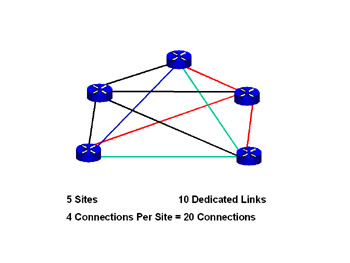
As Rag-Tag Books becomes more and more popular, you find that you are opening branches all over town. Your store-to-store network becomes very complex, with dedicated private lines between all of your buildings in what is known as a mesh network (see Figure 7.1).
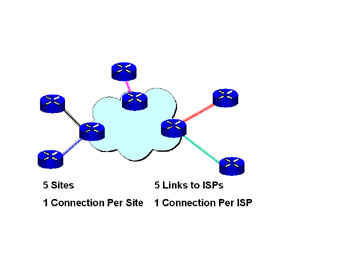
You need the privacy that dedicated lines give you, but the expense of private lines becomes a problem. You decide to look into a Virtual Private Network (VPN). A VPN is a network of computers that uses public carriers to interconnect the individual computers (see Figure 7.2).
In days gone by companies would establish networks between their sites. They would own, manage, and control every aspect of these private networks. The ownership of their networks ensured a high level of security. As firms moved toward becoming more cost-conscious, they started to outsource network ownership and operations; however, the reduced operational costs came with increased security risk. Firms found that their data was exposed to being diverted, copied, read, and even played back.