Rotary Wing Structural Dynamics and Aeroelasticity, Second Edition

Chapter 4: Gyroscopics

In the preceding chapter the basic vibrational characteristics of a flexible rotating beam (representative of a rotor blade) were developed with the emphasis placed on the additional stiffening provided by the centrifugal forces. In this chapter we explore another aspect of the dynamics of rotation wherein the axis of rotation itself is rotated. The tools resulting from this development address a basic dynamic phenomenon inherent in rotorcraft structural components in an ever-increasing variety of operational conditions.

4.1 Rotational Motion of a Solid Body

4.1.1 Angular Momentum and Dynamic Equation

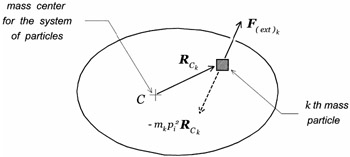
Consider a system of particles such as that shown in Fig. 4.1.


Figure 4.1: Rotational kinematics of a mass particle.

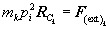
Newton's law applied to the kth mass particle is as follows:

(4.1)

where p i is the time derivative with respect to the (fixed) inertial coordinate system. We can then take the cross product of with this equation where is the vector from the mass center of the solid body to the kth mass particle, noting that

(4.2)

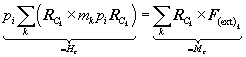
After taking the cross product and summing over all of the particles, we obtain

(4.3)

where H c is the angular momentum of the system of particles about its mass center.

The equation of dynamic equilibrium then becomes

(4.4)

Two difficulties arise with this equation for a rigid body:

  1. The angular momentum, as given earlier, is obscurely defined.

  2. Differentials with respect to inertial space are awkward when one deals with rapidly and complexly rotating rigid...

UNLIMITED FREE
ACCESS
TO THE WORLD'S BEST IDEAS

SUBMIT
Already a GlobalSpec user? Log in.

This is embarrasing...

An error occurred while processing the form. Please try again in a few minutes.

Customize Your GlobalSpec Experience

Category: Inertial Navigation Systems
Finish!
Privacy Policy

This is embarrasing...

An error occurred while processing the form. Please try again in a few minutes.