Rotary Wing Structural Dynamics and Aeroelasticity, Second Edition

The blade flutter problem typically occurs at reduced frequencies (based on conditions at the 75% radius point) that make the neglect of true unsteady aerodynamic effects unacceptable from an accuracy standpoint. However, the mechanism of flutter is not necessarily dependent on the use of unsteady airloads. The divergence instability is an aperiodic one and therefore occurs at essentially zero frequency; hence, static airloads can be applied quite accurately. For these reasons the material presented in this section is based upon an incompressible (hovering) quasi-steady formulation. To a great extent the derivations of the appropriate equations of motion for blade flutter and divergence are extensions of the classical beam formulation equations originally used for fixed-wing flutter and divergence. The objective of the material presented herein is to formulate the basics of the problem so that the important interactional forces can be identified. Where practical, modifications for including more rigorous unsteady airloads are also presented.
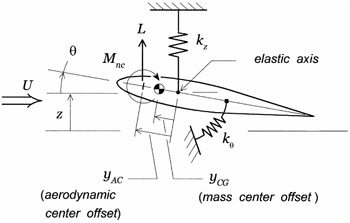
In contrast to the physics of the pitch-flap-lag instability problem, that of blade flutter and divergence is dictated by the interactions of the blade out-of-plane motion z and the torsional motion ?. Important couplings that exist between these degrees of freedom require that chordwise offsets of the aerodynamic and mass centers relative to the elastic (shear) center y AC and y CG, respectively, be taken into consideration. These features are depicted in Fig. 12.19, which shows a typical blade section.