Rotary Wing Structural Dynamics and Aeroelasticity, Second Edition

The use of elastomeric materials in the control of vibration and in rotor-stabilization devices is well established in current rotorcraft design practice. In this chapter we examine the basic properties of elastomeric materials and identify the critical issues relating their application to rotorcraft. The key component in all elastomeric devices is the elastomer itself, some form of a rubbery material that behaves very much like a structurally damped metal, only with significantly reduced elastic modulus but with a correspondingly enhanced loss factor. The material is typically bonded in thin layers alternately with equally thin layers of metal (or composite) to form a device that can serve both as a limited rotation bearing and/or as a source of damping. The majority of elastomeric devices used in rotorcraft applications typically utilize the elastomeric material in the shearing mode of deformation.
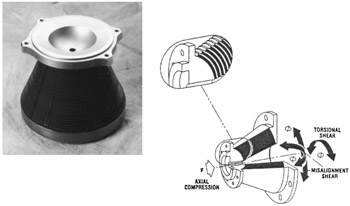
Figure 15.1 shows a typical spherical elastomeric bearing used to retain a rotor blade to the rotor hub.
This use of an elastomeric bearing serves several functions most elegantly. First, it serves as an efficient radial retention of the blade to the hub. An important property of elastomeric materials, when used in a laminated configuration, is that the compressive modulus normal to the laminates is relatively high. Hence, the spherical elastomeric bearing is ideal for this application. An alternate method for...