Structural and Stress Analysis, Second Edition

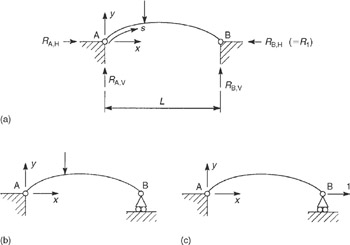
In Chapter 6 we saw that a three-pinned arch is statically determinate due to the presence of the third pin or hinge at which the internal bending moment is zero; in effect the presence of the third pin provides a release. Therefore a two-pinned arch such as that shown in Fig. 16.26(a) has a degree of statical indeterminacy equal to 1. This is also obvious from inspection since, as in the three-pinned arch, there are two reactions at each of the supports.
The analysis of two-pinned arches, i.e. the determination of the support reactions, may be carried out using the flexibility method; again, as in the case of portal frames, it is usual to ignore the effect of axial force on displacements and to assume that they are caused by bending action only.
The arch in Fig. 16.26(a) has a profile whose equation may be expressed in terms of the reference axes x and y. The second moment of area of the cross section of the arch is I and we shall designate the distance round the profile from A as s.
Initially we choose are lease, say the horizontal reaction, R1, at B, to obtain the statically determinate primary structure shown in Fig. 16.26(b). We then employ the unit load method to determine the horizontal displacement, ? B,H, of B in the primary structure and the flexibility coefficient, a 11. Then, from...