Structural and Stress Analysis, Second Edition

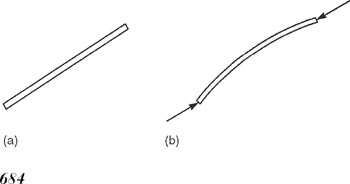
So far, in considering the behaviour of structural members under load, we have been concerned with their ability to withstand different forms of stress. Their strength, therefore, has depended upon the strength properties of the material from which they are fabricated. However, structural members subjected to axial compressive loads may fail in a manner that depends upon their geometrical properties rather than their material properties. It is common experience, for example, that a long slender structural member such as that shown in Fig. 21.1(a) will suddenly bow with large lateral displacements when subjected to an axial compressive load (Fig. 21.1(b)). This phenomenon is known as instability and the member is said to buckle. If the member is exceptionally long and slender it may regain its initial straight shape when the load is removed.
Structural members subjected to axial compressive loads are known as columns or struts, although the former term is usually applied to the relatively heavy vertical members that are used to support beams and slabs; struts are compression members in frames and trusses.
It is clear from the above discussion that the design of compression members must take into account not only the material strength of the member but also its stability against buckling. Obviously the shorter a member is in relation to its cross-sectional dimensions, the more likely it is that failure will be a failure in compression of the material rather than one due...