Structural Health Monitoring with Piezoelectric Wafer Active Sensors

Chapter 4: Vibration of Plates

4.1 ELASTICITY EQUATIONS FOR PLATE VIBRATION

In this chapter, we will analyze plate vibration. After reviewing the general plate equations, we will consider two situations separately: (a) axial vibration of plates; and (b) flexural vibration of plates.

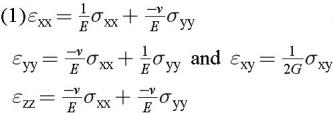
Because the plate surface is free, the z-direction stress is assumed to be zero ( ? zz = 0). Also zero are assumed to be the surface shear stresses ? yz = 0 and ? zx = 0. Hence, the 3-D elasticity relations given in Appendix B reduce to


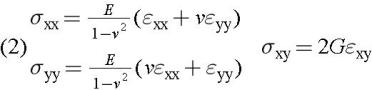
In our analysis, we are only interested in the strains ? xx, ? yy, ? xy. Solution of Eq. (1) yields


4.2 AXIAL VIBRATION OF RECTANGULAR PLATES

Axial vibrations are related to extension/compression motion in the plate, i.e., the motion is in-plane polarized.

4.2.1 GENERAL EQUATIONS FOR AXIAL VIBRATION OF RECTANGULAR PLATES

Assume in-plane displacements u( x, y, t) and v( x, y, t) which are uniform across the plate thickness. The strains of interest are


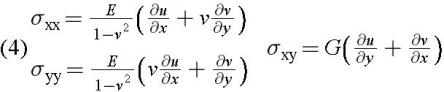
The strains are constant across the plate thickness. Substitution of Eq. (3) into Eq. (2) yields


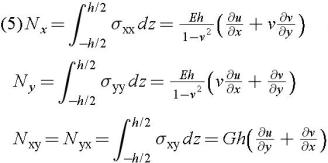
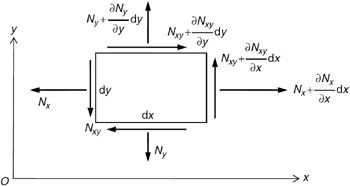
Note that the stresses are also constant across the plate thickness. Integration of stresses across the plate thickness gives the stress resultants (forces per unit width) N x, N y, and N xy shown in Fig. 4.1, i.e.,


Figure 4.1: Infinitesimal plate element in Cartesian coordinates for the analysis of in-plane vibration.

Newton...

UNLIMITED FREE
ACCESS
TO THE WORLD'S BEST IDEAS

SUBMIT
Already a GlobalSpec user? Log in.

This is embarrasing...

An error occurred while processing the form. Please try again in a few minutes.

Customize Your GlobalSpec Experience

Category: Heat Exchangers
Finish!
Privacy Policy

This is embarrasing...

An error occurred while processing the form. Please try again in a few minutes.