Structural Health Monitoring with Piezoelectric Wafer Active Sensors

11.10: PHASED ARRAY ANALYSIS USING FOURIER TRANSFORM METHODS

11.10 PHASED ARRAY ANALYSIS USING FOURIER TRANSFORM METHODS

So far, our analysis of the PWAS phased arrays has been performed in the time domain by applying simple delay-and-sum principles to a spatially-defined array of transmitters receivers. However, further insight into the function of phased arrays can be gained via Fourier analysis. Using Fourier analysis, one gains a better understanding of the fundamental principles of the phased-array method. In this section, we will recall some fundamental results of the space time Fourier transform and apply them to the study of wave propagation through spatial apertures. This will be expanded to the study of sampled wave signals propagating through sampled spatial apertures, which are representative of phased array geometries.

11.10.1 SPATIAL-FREQUENCY ANALYSIS

11.10.1.1 Fourier Transform

A short review of the Fourier transform principles is given next; further details of the Fourier transform definitions and properties are given in Appendix A.

Consider a signal x( t) defined on ( ?, + ?). Its Fourier transform is defined as


The inverse Fourier transform is defined as


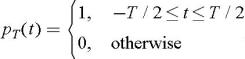
A rectangular pulse p T ( t) as shown in Fig. 11.63a is defined in time domain as


Its Fourier transform is the sinc function, i.e., , i.e.,


The spectrum of this signal is plotted in Fig. 11.63b. Notice that the sinc( x) function is equal to 1 at the point x = 0. The function sinc( x) crosses zero at x = 1, 2 , . Therefore,

UNLIMITED FREE
ACCESS
TO THE WORLD'S BEST IDEAS

SUBMIT
Already a GlobalSpec user? Log in.

This is embarrasing...

An error occurred while processing the form. Please try again in a few minutes.

Customize Your GlobalSpec Experience

Category: Imaging Spectrometers
Finish!
Privacy Policy

This is embarrasing...

An error occurred while processing the form. Please try again in a few minutes.