Value Innovation Portfolio Management: Achieving Double-Digit Growth Through Customer Value

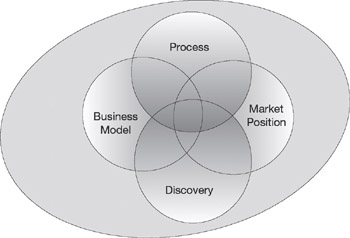
An innovation may take many strategic forms, from a simple product or service to a complex business model (see Figure 2.1). It may span a spectrum from new and evolutionary to revolutionary and disruptive. Whatever the route, a company must fully understand the realms of innovation, so it can present its case to the marketplace for approval by the jury of customers.
Traditionally, innovation in business referred to a discovery that involved a flash of creative insight or an aha! moment. This definition is only one of several dimensions along which organizations now innovate:
Process. Altering the methods for delivering goods and services. Federal Express exemplified this with its 1986 introduction of SuperTracker, a handheld bar code scanner system to capture detailed package information and the ability to track packages from pick-up to delivery [5] In 1990, SuperTracker won the prestigious Malcolm Baldrige National Quality Award for technical excellence, and in 2003 FedEx introduced handheld and wireless systems that further improved delivery times and tracking updates.
Market position Changing the way the product is marketed. A company weaves its product/market segment fabric by matching the solutions it offers to customer problems in that market segment. The stronger the linkage between the solution and the problem, the tighter the weave in the product/market segment fabric. Holes in the fabric occur when a business or its competitors are not addressing market problems. Market position innovation occurs...