Voice over IP: Systems and Solutions

Provides an extensive look at Voice over Internet Protocol (VoIP) and its effects on the communications industry.
 TABLE OF CONTENTS
 B Rosen
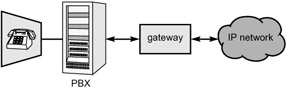
Generally, a device that sits between two different types of network technology is called a 'gateway'. As identified in Chapter 1, a common gateway for telephony sits between the current TDM domain and the emerging packet domain, such as an IP network. For example, in H.323, a gateway is a device that connects conventional telephones to an H.323 network. In principle, gateways could connect directly either to an analogue telephone, to a PBX (Fig 7.1), or to a TDM telephony switch on one side, and to an ATM, IP or MPLS network on the other side.
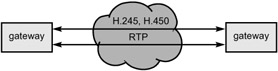
Gateways can also connect two packet domains (Fig 7.2). For example, a device could be built that takes ATM AAL2 voice on one side and produces VoIP (RTP) on the other side. Even a device that provided transcoding between two compression algorithms, but otherwise maintained the same transport, considered to be a gateway.

In the context of the media gateway control protocols discussed in this chapter, gateways may also include devices that provide services to audiovisual conferences, such as MCUs and IVR boxes.
As discussed in Chapter 1, in a conventional gateway, the same device that provides the media conversion from TDM to packet also provides the signalling interworking (Fig 7.3).
A new class of gateway has been proposed that splits the media-handling function from the signalling function. These 'decomposed'...