ARBURG Practical Guide to Injection Moulding

Chapter 4: Injection Mould Tooling Basics

4.1 Types of Moulds

An injection mould tool has two major purposes:

  • It is the cavity into which the molten plastic is injected

  • The surface of the tool acts as a heat exchanger (as the injected material solidifies with contact)

Injection mould designs differ depending on the type of material and component being moulded. Mould tool design and component design are equally important considerations for success. Component design is beyond the scope of this book but the various tooling, gating, temperature control and ejection systems that make up the mould tool will be considered here. After parts are injection moulded they must be ejected. A variety of mechanisms can be employed such as ejector pins, sleeves, plates or rings.

The design standard for injection mould tools is the two-plate design.

4.1.1 Two-Plate Mould

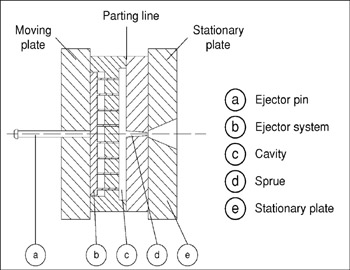
This is the simplest mould design. Mould cavities are formed in one plate only with the stationary half of the mould blank. A central sprue bushing can be placed into the stationary half of the mould or it is possible to have a direct runner system to a multi-impression mould. The moving half of the mould contains the ejection mechanism. This is illustrated in Figure 4.1


Figure 4.1: Two-plate injection mould

4.1.2 Stripper Mould

A stripper mould is very similar to the standard two-plate mould except for the ejection system. This design has a stripper plate for ejection, whereas the standard one has pins or sleeve as the ejectors. This is illustrated in Figure 4.2. The...

UNLIMITED FREE
ACCESS
TO THE WORLD'S BEST IDEAS

SUBMIT
Already a GlobalSpec user? Log in.

This is embarrasing...

An error occurred while processing the form. Please try again in a few minutes.

Customize Your GlobalSpec Experience

Category: Rubber and Elastomer Molding Services
Finish!
Privacy Policy

This is embarrasing...

An error occurred while processing the form. Please try again in a few minutes.