ARBURG Practical Guide to Injection Moulding

The control system is there to ensure repeatability during moulding operation. It monitors both the hydraulic system and the process parameters such as temperature, injection speed, screw retraction speed and injection and back pressure. The ability to control the process has a direct impact on final part quality, part to part consistency and economy. The nature of the control system may vary from a simple relay switch to a complex microprocessor system with closed-loop control. Some of the components of the machine control system will now be introduced.
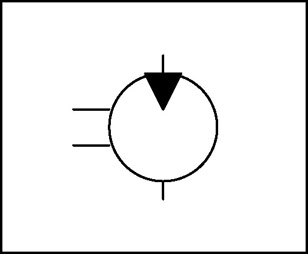
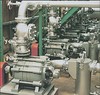
The hydraulic pump generally draws the hydraulic fluid from the supply reservoir and delivers it to the pump outlet. From here, it is conveyed through valves to the consumer and then returned. Figure 5.1 illustrates the symbol used to show a pump.
Hydraulic motors transform the hydraulic energy supplied by the pumps back into a mechanically-utilised working force with a rotary motion. Figure 5.2 illustrates the symbol used to represent a motor.
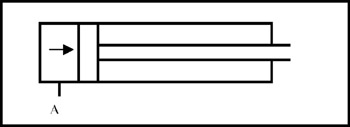
The cylinder (located behind the injection unit) is charged with hydraulic fluid through valves in the base and the head. Through this, a motion is transferred through the piston surface of the working cylinder to the piston' connecting rod. Single and double-acting cylinder are shown in Figure 5.3 and Figure 5.4