ARBURG Practical Guide to Injection Moulding

This section is split into four main areas:
Multi-component injection moulding
Assisted moulding
Multi-shot moulding
Over-moulding
Each of these areas will be now be discussed in turn.
This method describes a process whereby plastics are injected into one mould during a single injection cycle. The most common process in this category is co-injection moulding. Other less common variants are bi-injection and intermittent techniques.
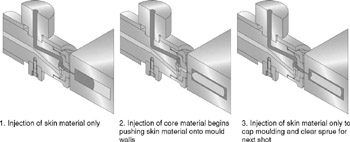
Co-injection moulding is a variant of the standard injection process and has been in use since the early 1970s. A number of terminologies are used that can encompass this process such as sandwich moulding, 2K (2-component) or 3K (3-component) and dual-injection or multi-component. For the purpose of this chapter, co-injection moulding is the preferred terminology. This technique offers the advantages of combining two or more material properties to produce a sandwich structure. This is achieved by making sequential injections into the same mould with one material as the core and another as the skin. This is illustrated in Figure 10.2.
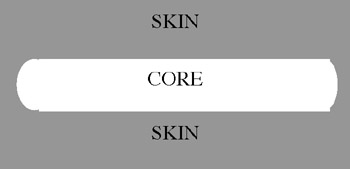
The result is the distinctive sandwich structure of skin and core as shown in Figure 10.3.
Co-injection moulding offers numerous possibilities in terms of a variety of material combinations, some of which are shown in Table 10.2.
| Material combination | Properties | Application |
|---|---|---|
| Soft feel skin/hard core | High strength core with... |