Building Aerodynamics

Written specifically for practicing Architects and Engineers, as well as students, this thorough guide explains topics such as wind, wind environments, ventilation, fire, and sailing, and the relevant expressions they present.
 TABLE OF CONTENTS
 The application of Buckingham's Theorem to flow over buildings was explained in Section 2. Here we will be interested in applying it to wind loads and this involves ensuring that the data we use apply the concept of "Dynamic Similarity".
There are two sources of data, from Codes or published data, and from wind tunnel investigations. These sources can supply incompatible data in that reference conditions may be different, and care must be taken when they are mixed.
It will be assumed that, in any wind tunnel investigation the correct velocity profile and turbulence profile will have been installed in the wind tunnel, for the reasons given in Section 2.
This is the term applied to the fluctuating force produced by a fluctuating wind speed. At first it was assumed that a unique value of Pressure Coefficient applied, and that the pressure was given by the expression
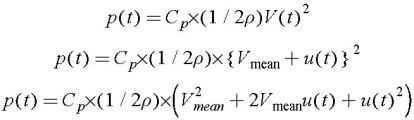
which is sometimes linearised to

but, in the era of computers, I would not recommend the linearised form.
In the wind tunnel, where the reference wind speed is the hourly-average and all fluctuations are contained in the value of the Pressure Coefficient, the expression used is

In real life the time-varying pressure at a point can be written

the peak value of p, written as p ? ( t), would appear to be given by

where V ?( t) is the peak value...