Building Aerodynamics

Written specifically for practicing Architects and Engineers, as well as students, this thorough guide explains topics such as wind, wind environments, ventilation, fire, and sailing, and the relevant expressions they present.
 TABLE OF CONTENTS
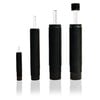
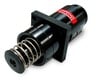
 A damper is a device which converts movement energy into heat, and in doing so, reduces the energy of the movement. The dissipation of energy occurs in either a solid or liquid component of the damper.
There are two types of damper, the first can be attached to two parts of a structure which have relative movement. The second type is attached to a structure which moves, and the damper has to supply within itself a part which moves differently from the point of attachment.
The simplest form of this type of damper is a dash-pot, a porous piston in a cylinder filled with oil. The movement of the piston relative to the cylinder squirts oil through the piston, the velocity of the oil ultimately converting the energy into heat. A wide variety of silicon oils with different viscosities are available commercially.
Some solids, called elastomers, perform the same operation.
The advantage of this type of damper is that it adds little weight to the structure.
In the simplest form of this type of damper, the reference point is a mass. If this mass is attached to the member to be damped by stiffness and damping devices, the result would be a system such as that shown in Figure 3.09. If the natural frequency of the damper is far removed from the...