Determination of Additives in Polymers and Rubbers

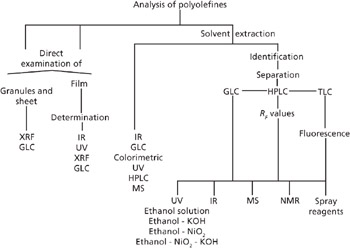
The scheme outlined in Figure 2.1 has been proposed for the solvent extraction and examination of PE [1]. Some useful solvents are listed in Table 2.2.
| Polymer type | Substance extracted | Extracting solvent | Comments | Ref. | Type of extraction |
|---|---|---|---|---|---|
| PE | Cresolic and phenolic antioxidants | Chloroform | Heat at 50 C for 3 hours in a closed container | [1] | Fractional extraction |
| PE | Cresolic antioxidants | Hexane | Heat at 50 C for 24 hours | [2] | Fractional extraction |
| PE | Cresolic antioxidants | Ether | In the dark at 20 C | [3] | Fractional extraction |
| PE | Phenolic antioxidants | Chloroform | [4] | Fractional extraction | |
| PE | Antioxidants | Toluene | Reflux to dissolve polymer in precipitate with methanol | [5] | Fractional precipitation |
| PE | Antioxidants | Water | At 70 C under nitrogen | [6] | Fractional extraction |
| Source: Author s own files |
Details of particular solvent extraction schemes for polyethylene are described in more detail next.
Toluene-Methanol Extraction System
Total internal plus external additives can be extracted from low and high-density polyethylene (HDPE) and polystyrene (PS) by procedures involving solution or dispersion of the polymer powder or granules (3 g) in cold redistilled sulfur-free toluene (50-100 ml) followed in the case of PE, by refluxing for several hours. Rubber-modified PS does not completely dissolve...