Determination of Additives in Polymers and Rubbers

Whilst it is not an additive, for completeness, the determination of water in polymers is briefly discussed here.
Jeffs [1] has developed a versatile gas chromatographic unit (GC), described next, for the determination of water and other volatiles in vinyl, acrylic and polyolefin polymer powders.
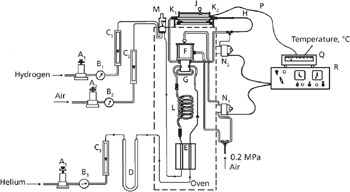
The instrument is shown diagrammatically in Figure 10.1, and consists essentially of a sample tube, forming an external loop, connected to a GC. This loop can be isolated and the sample heated to the required temperature. After an initial heating period the volatile constituents liberated from the sample are flushed on to the chromatographic column by a flow of carrier gas through or over, the sample, and the required components are separated and determined quantitatively. A pneumatic switch valve, located in the chromatographic oven to prevent the condensation of volatile constituents within the valve, and a split heater mounted on a horizontal travel in a plane at right angles to the sample tube are essential parts of the apparatus. The instrument is semi-automatic.
The apparatus shown in Figure 10.1 is fitted with katharometer and flame-ionisation detectors (FID). Although only one detector is necessary for any one specific method, e.g., a katharometer for the determination of water in polymer powder, it is invaluable to have both available (with separate recorders) to establish the conditions, i.e., in the above case to ensure that no...