Dynamic Plasticity

Including a full introduction to the elementary theory of plasticity, this book presents a self-contained and comprehensive look at the field of dynamic plasticity for researchers and graduates in mechanical engineering.
 TABLE OF CONTENTS
 The constitutive equation for rocks or soils is much more complicated. The reason is that the experimental results are much more involved. Even the elastic constants are no more what they were for metals, and the methods of finding them from tests are different from what we know from metals. The yield conditions are different. While for metals a cylindrical constitutive yield condition, independent of the mean stress is quite normal, such a yield condition for rocks is not acceptable. One has tried to introduce a yield condition depending also on mean stress and on the third deviator stresses

where
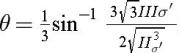
is the Lode angle. The most familiar are the Mohr-Coulomb and Drucker-Prager yield conditions.
The first condition is written

with

The Drucker-Prager yield condition is

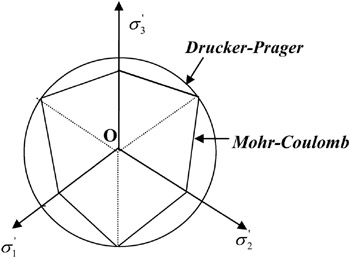
with a and k constants. For a fixed pressure the two surfaces are represented in Fig. 2.1.1. They are conical in three-dimensional space, but for a constant pressure they show as in figure.
Generally the criteria can be written (Li and Aubertin [2003], Aubertin and Li [2004], Li et al. [2005]):

where ?, ? 1 , ? 2 and I c are material parameters, ? is expressed as function of the friction angle ?=  and II=J 2 , while

where b is linked to the shape of the surface in the ? plane. The authors have investigated the relationship...