Dynamic Plasticity

Including a full introduction to the elementary theory of plasticity, this book presents a self-contained and comprehensive look at the field of dynamic plasticity for researchers and graduates in mechanical engineering.
 TABLE OF CONTENTS
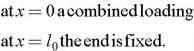
 Let us consider now the problem of a thin wall tube, loaded at one of its end by tension and torque. Thus we have two loadings, and we expect a combined load. The boundary conditions are:
We are using cylindrical coordinates x, r, and ?, and the displacements are u, ? and w=0. Thus the velocity components are u t , ? t , and 0. The stress components are ? r , ? r ? , and ? rx are assumed to be small, at least compared with ? xx = ? and ? ?x = ?, which are dominant. We assume also axial-symmetry thus ( ?/ ??)=0.
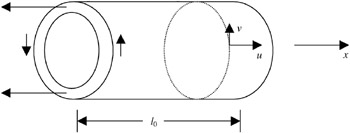
The equations of motion are:
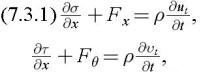
where F x and F ? are the corresponding body forces, and ? is the constant density.
The strains are:

We use also the noticing

We introduce now the constitutive equations. We introduce one in very general form and we particularize it later on. Thus, assuming small strains,

For the elastic we assume the Hooke s law:
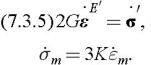
The plastic part of the strain rate, satisfy a general constitutive equation of the form:
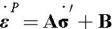
where A is a fourth order tensor and B a second order tensor. For our case we have
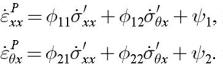
Introducing here the Hooke s law, these equations becomes:
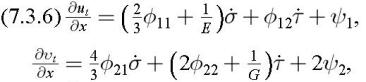
where

In order...