Dynamic Plasticity

Including a full introduction to the elementary theory of plasticity, this book presents a self-contained and comprehensive look at the field of dynamic plasticity for researchers and graduates in mechanical engineering.
 TABLE OF CONTENTS
 This chapter is devoted to the motion of a Bingham body through various devices; through a tube with or without friction at the wall, flow in a viscosimeter, flow in the field of natural slopes, etc. Plastic flow through conical converging dies will not be described (Cristescu [1975] [1976], Fu and Loo [1995]). For general concept on strain rate intensity factor see Aleksandrov et al. [2003].
We consider a tube of length l and of radius R (Buckingham [1921]). We work in cylindrical coordinates.
At z=0 we have (Fig. 6.1.1)

that is a pressure is applied.
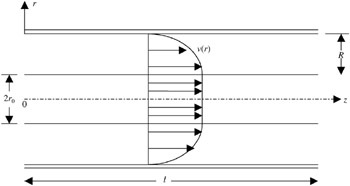
We assume telescopic flow i.e.,

The rate of deformation tensor in cylindrical coordinates are

From here for our problem we have

The constitutive equation for a Bingham (viscoplastic/rigid) fluid is:

with the plastic part

If only

From (6.1.3) and (6.1.5) we obtain

Thus for the only non zero component:

We observe now that f ?<0 or ( ?? z / ?r)<0 since ? z decreases with increasing r. Therefore sign D rz= ?1. Since all D ij=0 all  =0, besides D rz and ? rz. We have thus

The equations of motion in cylindrical coordinates are:
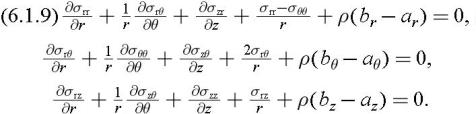
Introducing (6.1.8) in (6.1.9) 1 and (6.1.9) 2, and by disregarding the body forces and the accelerations, we have:
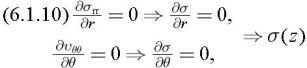
thus ? depends on z