Geometric and Algebraic Topological Methods in Quantum Mechanics

Algebraic quantum theory follows the hypothesis that a quantum system can be characterized by Hermitian elements of a C*-algebra A and positive forms f on A treated as mean values of quantum observables (see Remark 3.1.1 below). In accordance with the Gelfand-Naimark-Segal (henceforth GNS) construction, any positive form on a C*-algebra A determines its cyclic representation by bounded operators in a Hilbert space. This Chapter addresses some modifications of this GNS construction.
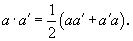
A product of two Hermitian elements need not be Hermitian, unless they mutually commute. As a consequence, Hermitian elements fail to make up an associative algebra. Therefore, one considers Jordan algebras in order to describe quantum observables [3; 144]. Hermitian elements of an involutive algebra constitute a Jordan algebra with respect to the symmetrized product
Subsections: A. Involutive algebras, 195; B. Hilbert spaces, 198; C. Countably Hilbert spaces and nuclear spaces, 201; D. Operators in Hilbert spaces, 202; E. Representations of involutive algebras, 204; F. The GNS representation, 206.
We start with a brief exposition of the conventional GNS representation of C*-algebras [129]
A complex algebra A is called involutive, if it is provided with an involution * such that
Let us recall the standard terminology. An element a ? A is normal if aa* = a*a, and it is Hermitian or self-adjoint...