10.2 Hopf Algebras
In this Section, the relevant basics of Hopf algebras is summarized [98; 293].
Let  be a complex unital algebra, i.e., a ?-ring. The tensor product
  of algebras
  is defined as that of vector spaces
  provided with the multiplication
Let us write the multiplication operation of the algebra  as a ?-linear morphism
A coalgebra  is defined as a vector space
  provided with the following linear morphisms:
which obey the relations
| (10.2.1) | 
|
As a shorthand, one writes
| (10.2.2) | 
|
A comultiplication and a counit extend to tensor products pairwise, i.e.,
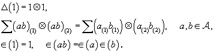
A bi-algebra (  , m, ?, ?) is defined as an associative algebra
  which is also a coalgebra so that
A Hopf algebra (  , m, ?, ?, S) is a bi-algebra
  endowed with a linear morphism
  , called the antipode, such that
It obeys the relations
where P : a ? b ? b ? a is the transposition operator. Let us note that, given a bi-algebra  , there is a unique antipode, if any, such that
  becomes a Hopf algebra.
For the sake of brevity, we call ?, ? and S the co-operations of a Hopf algebra.
A Hopf algebra is said to be cocommutative if P ? ? = ?. If a Hopf algebra is commutative or cocommutative, then


 TABLE OF CONTENTS