Materials for Advanced Energy Systems and Fission & Fusion Engineering: Proceedings of the Seventh China-Japan Symposium
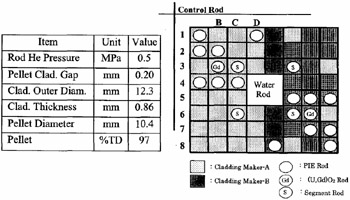
Step II fuel has an 8x8 lattice configuration of 60 fuel rods in which Zr-liner and high corrosion resistant cladding tubes are used. Its design maximum bundle burnup is 50GWd/t. The bundle design has a central large diameter water rod to soften the neutron spectrum. It uses ferrule-type spacers in place of the earlier grid-type ones to improve thermal hydraulic performance. Furthermore, some design improvements to reduce fission gas release, such as an increased initial He pressure, increased pellet density and decreased gap width between pellet and cladding, are incorporated. The design parameters and fuel rod arrangement in the fuel assembly are shown in Figure 3 [1] , [11].
Eight fuel assemblies, some of which were equipped with segment rods for power ramp tests were fabricated by Japan Nuclear Fuel Co., Ltd.
Eight test assemblies were loaded in a relatively high power position in the core of Fukushima Daini Nuclear Power Station No. 2 Unit, operated by Tokyo Electric Power Co., in 1989. They were irradiated up to 5 irradiation cycles under normal BWR conditions and one assembly was discharged after each cycle for detailed PIES. The reactor was operated at almost full power through the five cycles.
Irradiation history of 5-cycle irradiated fuel assembly is shown in Figure 4. Maximum linear heat rates of LUAs were kept...