Mathematical Methods For The Natural And Engineering Sciences

If the differential equations modeling a particular system depend on a real parameter, ?, then it is expected that the solutions will also have a dependence on the parameter, i.e.,
A value ?* of the real parameter ? such that the qualitative properties of the trajectories in phase space change their fundamental character, as ? passes through ?*, is called a bifurcation point.
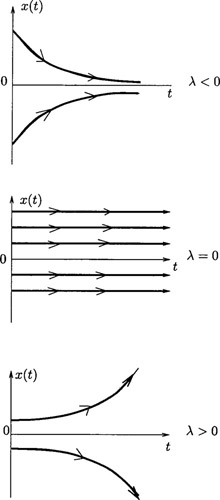
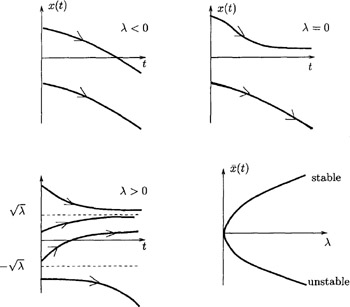
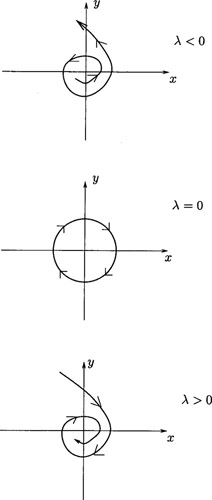
Figures 4.6.1, 4.6.2, and 4.6.3 illustrate this phenomenon. First, Figure 4.6.1, shows the behavior of solutions to the differential equation

for various values of the parameter ?. For all three cases studied, the fixedpoint is x( ?) = 0. While the fixed-point does not depend on ?, its stability properties do. The three cases are:
? < 0: All solutions monotonically decrease in value to zero. The fixed-point is stable.
? = 0: All solutions are constant, i.e.,
These solutions have neutral stability; this means that changing the initial condition changes the solution, but only by a finite amount if the change in the initial condition was finite.
? > 0: All solutions are monotonically increasing and become unbounded, i.e.,
For this equation, it is clear that ?* = 0.
The second equation presented is
There...