Mathematical Methods For The Natural And Engineering Sciences

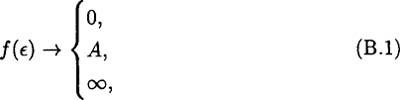
Let f( ?) be a function of the real parameter ?. If the limit of f( ?) exists as ? tends to zero, then there are three possibilities:

with 0 < A < ?. (The case where f( ?) has an essential singularity at ? = 0, such as sin( ? ?1) or exp( ? ?1), is excluded.) In the first and last cases, the rate at which f( ?) ? 0 and f( ?) ? ? can be expressed by comparing f( ?) with certain known functions called gauge functions. The simplest and often most useful gauge functions are members of the set { ? n} where n is an integer. Other gauge functions used are sin ?, sinh ?, log ?, etc.
The behavior of a function f( ?), as ? ? 0, can be compared with a gauge function g( ?) by employing the symbols " O" and " o."
The symbol O is defined as follows: Let f( ?) be a function of the parameter ? and let g( ?) be a gauge function. Let there exist a positive number A independent of ? and an ? 0 > 0...