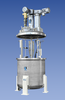
Mixing of Vulcanisable Rubbers and Thermoplastic Elastomers

There have been no significant improvements in mixing mills over recent times. The use of hydraulic drives, hydraulic nip control, drilled roll cooling and stock blenders was covered fully in the previous Rapra review report, and needs little further comment.
Use of hydraulic drives has allowed one manufacturer to introduce small mills with the ability to drive the rolls either forward or backwards, allowing extremely high shear to be achieved in the nip between the rolls (a.5, 216). Use of this mill would appear to be limited to laboratory applications, and the mixing of very soft materials such as silicone rubbers.
The basic design of all commonly-used batch mixers consists of two rotors contrarotating in a close-fitting chamber, with an arrangement to feed the raw materials into a machine, pressurising them into the mixing chamber using a ram, and with a door in the bottom of the machine to discharge the mixed batch. The kneaders are similar machines (Section 3.2.2.7), but they rely on a tipping movement of the mixing chamber to empty the mixed contents. Excluded from this simple description are the developments in novel mixing machinery mentioned towards the end of this section (Section 3.2.5).
Tangential rotor internal mixers - Mixers which are arranged such that the predominant mixing action is to shear the mixing compound against the sides of the mixer.
Intermeshing rotor internal mixers - Mixers which are arranged such that...