Mixing of Vulcanisable Rubbers and Thermoplastic Elastomers

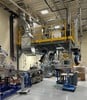
Continuous mixing equipment has long been used in the plastics industry for the compounding, filling and alloying (blending as it has always been known in the rubber industry) of thermoplastics. Development of the early thermoplastic elastomers (for example Santoprene) was carried out on continuous mixing machinery, and most thermoplastic elastomers manufactured today are still made on this type of equipment. Several machines have been suggested for use in the compounding of curable rubbers, and recent publications (95) indicate that there are now plants in existence utilising continuous mixing for these materials.
Whilst these are used for low quality compounding, particularly addition of filler to polyolefins, in the plastics industry, their use in compounding rubbers is negligible. Attempts have been made to 'mix' a compound by feeding two masterbatch strips, one of filled rubbers and one of curatives, but these have not proven very successful due to the inability to maintain strict proportions between the two ingredients.
Use of a blended pellet feed, where pellets of the two materials are accurately proportioned, will result in a usable compound, provided that both masterbatches are similar in viscosity, but extruder output is very much reduced compared to using a strip feed.
These machines are not viable for true compounding operations, although a modification of a single-screw extruder had limited success some years ago compounding low viscosity ethylene-propylene compounds. This was the EVK (Extruding, Venting, Kneading) machine made by Werner & Pfliederer. The present status of this machine is not known,...