Mixing of Vulcanisable Rubbers and Thermoplastic Elastomers

The major obstacle to the operation of continuous mixing is to obtain polymers, fillers and chemicals in suitable form, and maintain feed of the many dissimilar materials used in a range of vulcanisable rubber compounds. Continuous mixing of thermoplastic elastomers does not present the same problem, as a maximum of perhaps four feeds (rubber component, thermoplastic component, filler and oils/plasticisers) is likely in this case.
Although some rubbers, for instance some grades of EPDM and even some black filled rubbers (33, 113, 190), are becoming available in a powder form, for most rubber compounds to be processed continuously requires comminution of the rubber polymers. Although this is relatively easy using modern granulation systems, some partitioning agent is generally required on the polymer to prevent re-agglomeration. This could be carbon black, or any other filler used in a particular rubber compound, but this still begs the question of a universal partitioning material that could be used in any rubber compound. With the wide range of applications for rubbers, no such material is available.
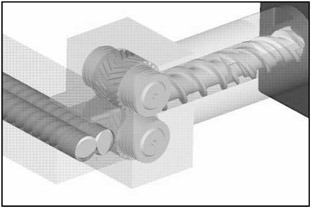
A potential method of overcoming this problem, suggested by Berstorff, is to use a short single-screw extruder and gear pump to feed raw rubber into the continuous compounding process (Figure 36), but even here bales would require breaking to a size suitable for feeding to the single-screw extruder.
The use of a gear pump feed of solid rubber...