Mixing of Vulcanisable Rubbers and Thermoplastic Elastomers

Chapter 5: Downstream Equipment

The equipment following a mixer depends very much on the products being made on that mixing line, with major differences found between large and small compounding plants, and between those lines mixing curable rubbers and those mixing thermoplastic materials.

5.1 Curable Rubbers

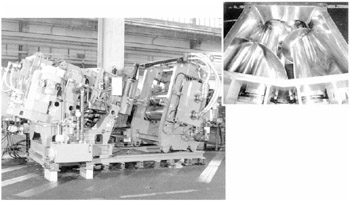
Advances made since the last Review Report in the equipment immediately following the batch mixer have been minimal, compared to the introduction of the biconical twin-screw dump extruder. The use of the twin-screw dump extruder has increased, particularly in the tyre industry, and to a lesser degree in the general rubber goods sector, and more manufacturers now make versions of this device. A typical unit is illustrated in Figure 30 and consists of two contrarotating biconical screws feeding a set of sheeting rolls. The advantage of this machine is the very low shear imposed on the mixed rubber, consequently it does not add significant temperature to the batch as found when using single-screw dump extruders. Drive to this extruder often uses two hydraulic motors due to space constraints - the only form of extruder yet to be driven by a hydraulic motor. Use of two motors, one to each screw and each with a separate drive control allows variation of screw speeds, one to the other, which is said to improve self-cleaning of the twin-screw machine (a.13).


Figure 30: Twin-screw dump extruder ( Courtesy of Techint Pomini)

A development to this machine introduced by one company (a.13) has seen the fitting of a gear pump to the...

UNLIMITED FREE
ACCESS
TO THE WORLD'S BEST IDEAS

SUBMIT
Already a GlobalSpec user? Log in.

This is embarrasing...

An error occurred while processing the form. Please try again in a few minutes.

Customize Your GlobalSpec Experience

Category: Tire Manufacturing Equipment
Finish!
Privacy Policy

This is embarrasing...

An error occurred while processing the form. Please try again in a few minutes.