The Mould Design Guide

The term runnerless moulding is used to describe any mould tool where a conventional cold runner and sprue is not produced:
Sprueless moulding
Insulated runner systems
Hot runner systems
There are two main categories for sprueless moulding:
Basic antechamber designs
Heated hot sprue bushes or nozzles
Sprueless moulding is frequently used for fast-cycling single impression tools producing thin wall components in non-heat-sensitive materials such as PE, PP and PS.
This method usually consists of a specially formed machine nozzle, which is designed to fit into a recessed feature in the mould tool. The most basic designs incorporate an antechamber feature. With this arrangement, a thin skin of colder material insulates a molten central core between the nozzle and gate.
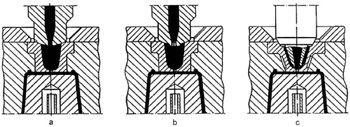
Figure 15.1 shows three typical designs of antechamber type nozzle. The design shown in Figure 15.1(b) has the advantage that if the melt in the nozzle solidifies to a cold slug, the undercut form on the nozzle permits easy withdrawal from the tool. Figure 15.1(c) shows an antechamber feed system without a cold slug well.
This approach may also be used for larger mouldings running on a single-impression basis where maximum control and quality are required.
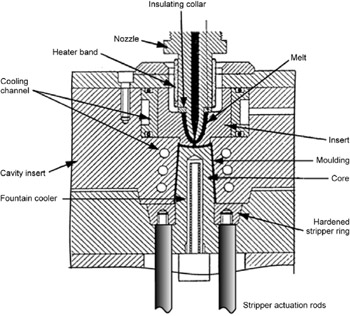
Sprueless moulding techniques may also be employed for more heat-sensitive materials. In these cases it is preferable to extend the nozzle as far as the gate, as in Figures 15.2 and Figure...