The Mould Design Guide

Chapter 23: Summary of Mould Calculations

The purpose of this summary is to bring together in one section, all the formulae in the book for convenience.

23.1 Production Rates


When a new mould tool is being considered, however, the expression is rearranged to estimate the number of impressions necessary to achieve a desired production rate:


23.2 Cooling Channel Diameters


where:

M = the shot mass in kg

H m = enthalpy at the material melt temperature in kj/kg

He = enthalpy at the moulding ejection temperature in kj/kg

The cooling capacity required is then this value divided by the cycle, i.e.,


where Q ? = the cooling capacity in kj/s.

For maximum cooling efficiency there should be a difference of 5 C between the cooling inlet and outlet temperatures.

The specific heat of water is 4.19. Therefore, it takes 4.19 kj of energy to increase the temperature of 1 kg of water by 1 C. Hence to raise it by 5 C we would need 5 4.19 = 20.95 kj.

The volumetric flow of water required to remove the heat in the mould is given by


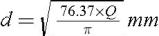
We also need a linear flow rate of 2.5 m/s to promote turbulent flow, hence the volumetric flow can also be expressed as Vf = 2.5 x cross-sectional area of channel. If the channel is circular we can write this as:


Transposing for d gives:


23.3 Runner Length Formulae

There are three equations that may be used which give a sufficiently accurate result for most moulding conditions:

UNLIMITED FREE
ACCESS
TO THE WORLD'S BEST IDEAS

SUBMIT
Already a GlobalSpec user? Log in.

This is embarrasing...

An error occurred while processing the form. Please try again in a few minutes.

Customize Your GlobalSpec Experience

Category: Circulation Heaters
Finish!
Privacy Policy

This is embarrasing...

An error occurred while processing the form. Please try again in a few minutes.