The Mould Design Guide

Core unscrewing is used to free internal screw thread forms and falls into two broad categories:
Core remains fixed with respect to the mould
Core moves axially with respect to mould
The method selected will depend upon the application and on the geometry of the component. In both categories, a system of gearing is used to transmit the rotary motion to the unscrewing core from the driving source. Driving sources are discussed later in this section.
Fixed core systems are the most widely used method for automatic unscrewing. With this system, the core rotates in a static plane, simply revolving with no axial displacement of the core relative to the mould tool.
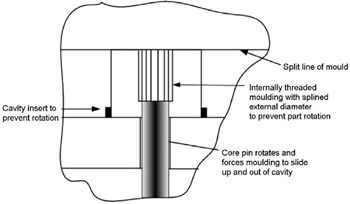
In operation, as the core rotates, the component is driven upwards out of the cavity until the part is completely unscrewed from the core. In order for this to occur, however, the component must be prevented from rotating with the core. This is achieved by effectively keying the part so that it cannot rotate. This is most usually arranged by providing a series of splines or serrations around the periphery of the part. This allows the part to move up the splined cavity as the unscrewing process takes place. Figure 13.14 shows a basic arrangement for this design.
The basic design shown is one of the simplest types of core unscrewing designs, but the unscrewing phase...