Nano-Engineering in Science and Technology

Focusing on the molecular dynamics method, this important book provides a vivid introduction to the procedures, techniques, problems and difficulties of computational nano-engineering and design.
 TABLE OF CONTENTS
 Now we would like to focus on nano-machines. In this case, the use of at least two different materials is unavoidable because we have to deal with movable parts. In our macroscopic world, the design of a simple bearing (which basically can be a drill-hole) and an axle (that can be a cylindrical rod) is not difficult. Both, bearing and axle may consist of the same material. Even if the rod has nearly the same diameter as the drill-hole, the axle is still movable due to the presence of a film of lubricant (water, dirt, air, grease, etc.). If we imagine the same situation at the nanometer realm, both parts would merge together forever.
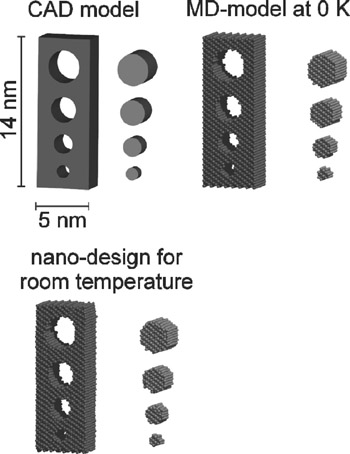
But there are still other difficulties. Due to the atomic structure, continuous surfaces and shapes are not possible at the nanometer level. Figure 5.5 shows the situation for simple bearings and axles of different diameters. That is, fits for nano-parts, made of crystalline structured materials, like metals or carbon (diamond), have to be designed rather loose.
Rotating parts are of particular interest in connection with nano-machines. The simulation of a rotating nano-structure is quite simple: the first design step is...