Nano-Engineering in Science and Technology

Focusing on the molecular dynamics method, this important book provides a vivid introduction to the procedures, techniques, problems and difficulties of computational nano-engineering and design.
 TABLE OF CONTENTS
 The following considerations are based on MD calculations for aluminium clusters consisting of 500 atoms [Schommers, Rieth, 1997; Rieth et. al, 2001]. The initial values for the positions have been chosen to be those of the bulk structure and the outer shape of the clusters has the form of a cube with (001) oriented surfaces. The inter-atomic interactions have been modeled with the Schommers potential using a cut-off radius of 7.35 which coincides approximately with the six nearest neighbor distance.
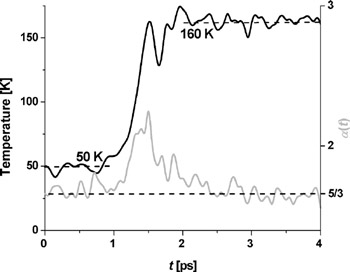
To gain a high accuracy for rather long time periods with respect to the trajectories the 6- value Nordsieck/Gear predictor-corrector integration algorithm has been used with a step width of 10 ?15 s. The initial velocities have been set according to a temperature of 50 K followed by an equilibration phase of 2000 time steps (2 ps). In the following, t = 0 refers to the end of the equilibration phase, i.e. the time at which the system has reached thermal equilibrium. Figure 5.10 shows the cluster temperature T and the ?-function (see Eq. 3.21) as a function of time t.