Nano-Engineering in Science and Technology

Focusing on the molecular dynamics method, this important book provides a vivid introduction to the procedures, techniques, problems and difficulties of computational nano-engineering and design.
 TABLE OF CONTENTS
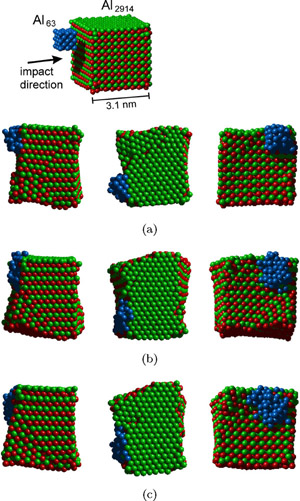
 It has already been discussed that large cubic aluminium clusters with (001) oriented surfaces build a rather stable phase while smaller cubes with the same face orientation show more or less extended meta-stable states which finally transit into stable configurations with mainly (111) structured surfaces.
As an example, without external influence an Al 2916 cluster (upper most picture of Fig. 5.24) does never leave such a "stable" state. This has been proofed for several initial conditions and periods of up to 150 ps. Since the considered MD models mirror ideal situations only, where no interactions with the environment take place (absolute vacuum), the question arises, whether an external stimulation can trigger a structural transformation in the same way as has been observed for smaller clusters without external influence.