Nano-Engineering in Science and Technology

Focusing on the molecular dynamics method, this important book provides a vivid introduction to the procedures, techniques, problems and difficulties of computational nano-engineering and design.
 TABLE OF CONTENTS
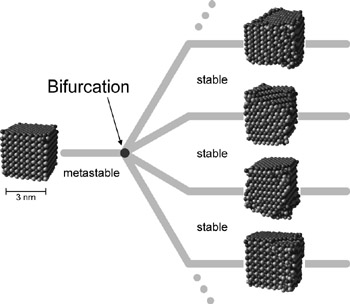
 In connection with meta-stable states of small clusters as well as with "pseudo stable" states of larger clusters the following effect (which has already been discussed in the previous sections) is of particular interest.
When a cluster makes the transition from a meta-stable or pseudo stable state to a stable state, there are several possibilities. In other words, the local minimum (saddle point) in the potential energy surface correlated to the meta-stable or pseudo stable state is surrounded by numerous deeper minima which correspond to the stable states. Which of these stable states the cluster will finally take cannot be predicted in principle. Due to the unavoidable energy fluctuations of nanosystems, it is completely a matter of chance.
That is, a cluster state transition is a bifurcation in the sense of chaos theory (see Fig. 5.27). Metaphorically speaking, at the bifurcation point nature plays dice to decide on which of the various branches (stable states) the cluster will finally rest.
The numerous MD studies presented in the previous sections have shown that stable cluster configurations may differ in both the inner structure as well as the outer shape. In general, the structures show multi-crystalline...